
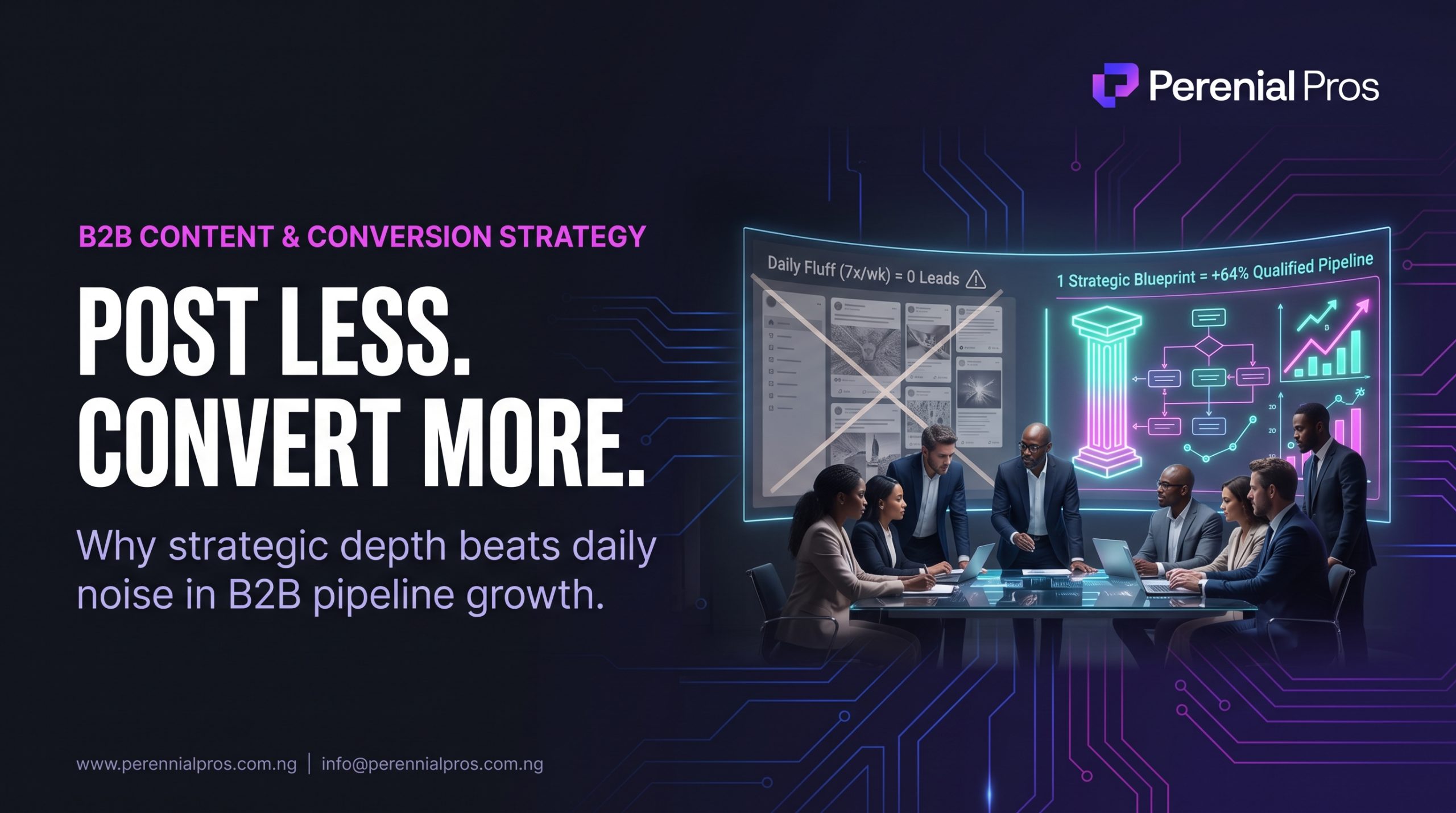
In the race to build brand awareness on social platforms, many B2B founders and marketing teams fall into the “daily output” trap.
The conventional advice across algorithmic platforms often preaches brute volume: post daily on LinkedIn, tweet five times a day on X, drop carousels on Instagram, and flood every feed to stay top-of-mind.
For high-ticket B2B agencies, consultancies, and digital solutions providers, this volume-first approach rarely produces qualified pipeline. More often, it leads to creative burnout, brand dilution, and an audience that scrolls past your posts because every update sounds like generic digital noise.
Executive decision-makers do not buy because you post seven days a week. They buy because the few times they encounter your thinking, it demonstrates undeniable technical competence, clarity, and authority.
Here is why reducing publishing frequency while dramatically increasing content depth is the most dependable path to high-value B2B lead generation.
1. The Quality Gap: Why Volume Destroys Positioning
In consumer marketing (B2C), high repetition reinforces impulse buys and entertainment retention. In B2B, the buyer is solving a high-stakes business risk, not making an emotional impulse purchase.
When your team forces an aggressive daily schedule, quality inevitably suffers:
- Shallow Content: You rely on superficial listicles (“5 AI tools you need today”) rather than nuanced, defensible case studies or proprietary architectural frameworks.
- Commoditization: When your output mirrors every other service provider using AI to churn out generic copy, your brand positioning flattens into a commodity.
- Perceived Scarcity: Category-leading consultancies and high-tier agencies don’t act like hyperactive content creators. Disciplined, measured publishing signals that your best minds are busy solving client problems, not constantly fishing for engagement.
A single comprehensive, field-tested breakdown published once a week will build more executive respect than seven days of filler posts.
2. Algorithms Now Reward “Dwell Time” and Depth
Platform algorithms on LinkedIn, X, and search engines have shifted significantly away from raw frequency toward depth of engagement.
Modern ranking signals prioritize:
- Dwell Time: How long an executive pauses and reads your breakdown before clicking away.
- Meaningful Conversation: Substantive comments and peer-to-peer discourse in the replies, rather than generic emojis or engagement pods.
- Saves and Reposts: Long-term reference value where prospects bookmark your blueprint to share internally with their leadership team.
A shallow post generates fleeting impressions that disappear in hours. A definitive, highly structured framework (like a deep dive on workflow automation or conversion architecture) continues circulating through algorithmic recommendation loops for days, compounding its inbound reach.
3. The 80/20 Distribution Formula: Build Assets, Not Feed-Filler
If you spend 90% of your operational bandwidth creating new posts every single day, you leave zero energy for strategic distribution and pipeline capture.
High-impact B2B content operations follow an asset-first model:
| Publishing Tier | Typical Rhythm | Asset Objective |
| Pillar Blueprint | 1–2 per week (e.g., Monday & Wednesday) | Deep-dive educational blog post solving an expensive operational bottleneck |
| High-Context Cutdowns | 2–3 per week | Native LinkedIn carousels or X breakdowns pulling direct diagrams and data from the pillar |
| Outbound / Lead Nurture | Ongoing | Repurposing published pillar links into direct sales conversations and automated onboarding emails |
Instead of asking “What should we post today?”, your question becomes “What single high-value problem can we document so thoroughly that an ideal client bookmarks it as an essential guide?”
4. Aligning Content with the “Quiet Majority”
A critical mistake in measuring content ROI is relying solely on public vanity metrics likes and comments.
In enterprise and high-ticket B2B:
- The loudest commenters are rarely the buyers. Decision-makers (CEOs, COOs, and department heads) are notoriously passive scrollers (“lurkers”).
- Buyers evaluate silently. They read your technical breakdown, assess whether you understand their specific industry challenge, and navigate directly to your website to book a diagnostic call without ever leaving a public “like”.
When your content is dense with genuine operational insight, backed by clear schematics, exact metrics, and actionable steps, you appeal directly to the silent decision-maker who values depth over hype.
5. The “Less But Better” Content Audit
Before publishing your next weekly slate of social assets, run your draft through this four-question filter:
- The Novelty Test: Does this post share a proprietary observation from our actual client work, or does it sound like a generic summary anyone could Google?
- The “Stealable” Insight: Can a prospective client immediately implement one concrete operational improvement from reading this?
- Visual Standard: Does the accompanying asset reflect the visual discipline of a premium B2B brand, or does it look like hurried stock imagery?
- Natural Next Step: Does the content lead logically into a low-friction diagnostic or discovery opportunity without aggressive pitch fatigue?
Authority Compounds When You Respect the Buyer’s Time
In a noisy digital landscape, restraint is a competitive advantage. By stepping off the content hamster wheel and committing to publishing fewer, exceptionally detailed operational blueprints, you establish your business as a serious authority worth paying for.
At Perennial Pros, we help growing B2B enterprises, founders, and consultancies build high-converting digital platforms, engineer automated operational workflows, and establish high-authority brand architectures that drive predictable inbound pipeline.
Ready to stop chasing vanity metrics and build a content-to-pipeline engine that scales?
👉 Contact the Perennial Pros team today to audit your digital presence and build a high-converting B2B content architecture.