
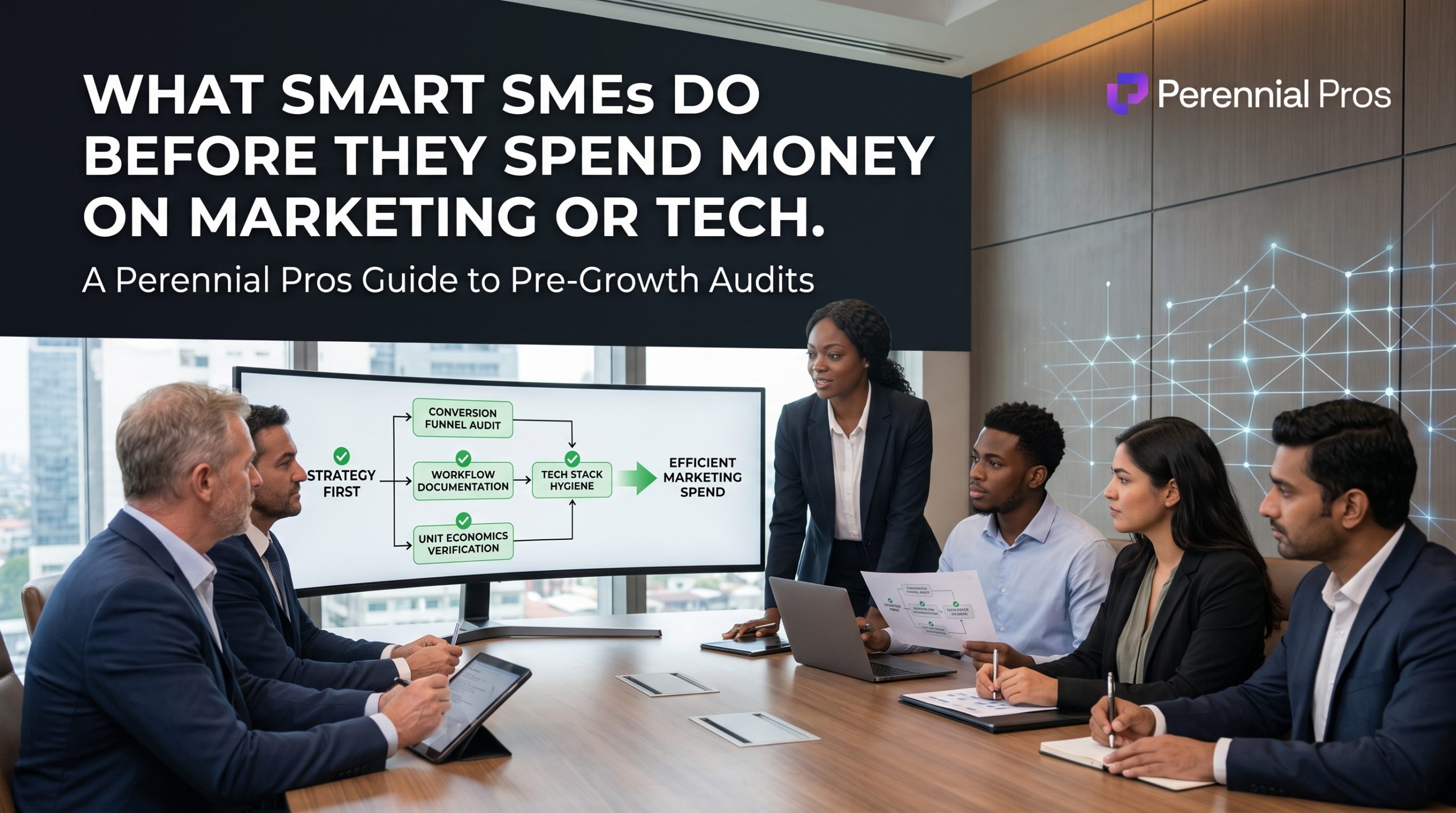
When growth slows down, the default reaction for many small- and medium-sized enterprise (SME) leaders is immediate spending: run paid ad campaigns, subscribe to another SaaS platform, or rebuild the company website.
Throwing money at marketing or technology rarely fixes underlying operational issues. If your core business model has leaks, more traffic and fancier software will only accelerate the rate at which you burn capital.
Sustainable, high-performing SMEs take a deliberate pause before approving a single purchase order. Here is the operational blueprint smart SMEs follow to prepare their business before spending money on marketing or tech.
1. Audit the Existing Conversion Funnel
Pouring paid traffic into a leaky funnel is one of the fastest ways to exhaust runway. Before running new ads or hiring an agency, evaluate every step a potential customer currently takes.
- Audit drop-off points: Track where prospects abandon inquiries. Is your contact form too long? Does your mobile site take more than three seconds to load?
- Identify speed-to-lead bottlenecks: If a prospect reaches out, how quickly do they receive a personalized response? Research consistently shows that responding within five minutes drastically increases conversion rates compared to waiting even an hour.
- Streamline the path of least resistance: Ensure your pricing, value proposition, and call-to-action (CTA) are completely unambiguous.
2. Document the Manual Workflow First
A golden rule of enterprise operations: never automate a broken or non-existent process.
Software does not create clarity; it digitizes existing habits. If your lead qualification, client onboarding, or invoicing processes are chaotic on paper, introducing a modern CRM or project management tool will only create automated chaos.
- Map out each step: Document the journey from first touch to delivery using a simple flowchart.
- Identify repetitive friction: Pinpoint exactly where human error happens most, such as manual data entry or missed follow-ups.
- Standardize before digitizing: Run the process manually until the handoffs are smooth, documented, and predictable.
3. Verify Product-Market Fit and Customer Unit Economics
Spending money to scale acquisition makes sense only when the underlying economics work.
- Customer Acquisition Cost (CAC) vs. Customer Lifetime Value (LTV): Know your numbers. Aiming for an LTV-to-CAC ratio of at least 3:1 ensures that scaling marketing will produce cash rather than burn it.
- Customer retention and churn: If your existing clients don’t stick around or refer others, paid marketing will simply mask retention issues temporarily.
- Qualitative customer interviews: Talk to your top 10% most profitable clients. Understand the exact problem you solved for them and why they chose you over competitors. Use their exact words to refine your messaging before paying for ad copy.
4. Run a Tech Stack Hygiene Check
Most growing businesses suffer from “subscription bloat.” Over time, teams accumulate redundant tools that overlap in function, fail to integrate, or sit unused.
| Asset Type | The Common Mistake | What Smart SMEs Do Instead |
| SaaS Subscriptions | Buying separate tools for email, invoicing, and CRM | Consolidating into unified ecosystems or using automated webhook bridges |
| Paid Advertising | Driving cold traffic directly to homepage | Directing targeted traffic to dedicated, high-converting landing pages |
| Data Tracking | Guessing performance based on vanity metrics | Setting up clean event tracking (Google Analytics 4, Meta Pixel) first |
Review every active recurring software fee. Cancel unused seats, terminate duplicate software, and ensure the tools you keep actively talk to one another via APIs or native integrations.
5. Calculate the True Total Cost of Ownership (TCO)
The sticker price of tech or marketing is only a fraction of what you ultimately spend. Smart businesses evaluate:
- Implementation & setup time: How many weeks of internal focus will this initiative require before producing results?
- Team training and adoption friction: Will the team actually use the tool, or will they default to old spreadsheets?
- Maintenance overhead: Who manages and optimizes the tech or campaign once it launches?
If adopting a new system requires months of disruption without a clear, measurable efficiency dividend, it is usually the wrong time to implement it.
Build Systems That Make Every Dollar Count
Capital efficiency separates resilient businesses from those perpetually chasing quick fixes. Before spending your next dollar on growth initiatives, ensure your foundation can support the weight of new demand.
At Perennial Pros, we help growing B2B businesses and founders streamline their digital operations, design high-converting platforms, and automate backend workflows. We ensure that when you turn on the growth tap, your business converts leads seamlessly and scales profitably.
Ready to eliminate friction and build an efficient, scalable operational foundation?
👉 Contact the Perennial Pros team today to schedule an operations and digital infrastructure audit.
Master Puppy Illustration: Capture Their Essence & Joy Unlock the secrets to drawing adorable puppy illustration!.